
 English



LES MAGICIENNES
sébastien bazou
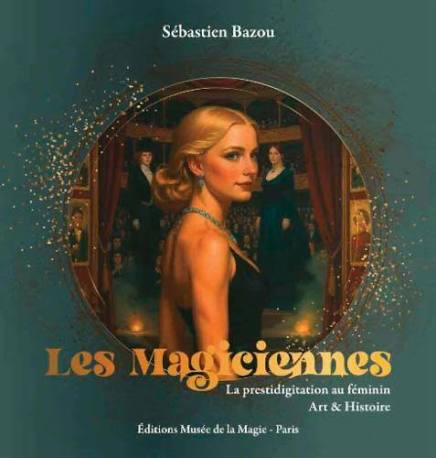

Les Magiciennes — History of women in magic:
Introduction:
Dear friends, dear friends of magical art, we are happy to present to you a new work, THE MAGICIANS: Prestidigitation in the Feminine – Art & History, a work that establishes a timeline of women practicing simulated magic from ancient times to the present day, across 2,500 years of history.
In 1896, Georges Méliès filmed Swindling of a lady at the Robert-Houdin Theater : the woman disappeared there by the will of a man. This book proposes the opposite operation.
For the first time, a publication retraces the history of women in conjuring, from Antiquity to the present day. From the priestesses of ancient Greece to the illusionists of the great contemporary stages – witches, conjurers, clairvoyants, sleepwalkers, telepaths, conjurers, physicists, mediums – more than three hundred and eighty documented female magicians, out of the three thousand eight hundred listed to date.
The Magicians spans twenty-five centuries and the major stages of this art: obscurantism, rehabilitation, golden age, triumph, recognition. A section is entirely devoted to French magicians from 1980 to 2025.
They are pioneers that the industry has little known, or deliberately ignored. Their story had to be written…
Composed of four chapters, with first of all the historical part written by Philippe Saint-Laurent addressing the “Representation of women in magic, from Antiquity to the 19th century” over 250 pages, through different incarnations of the magician: priestesses, women-monsters, witches, clairvoyants, conjurers, conjurers, physicists, telepaths, magnetizers, hypnotists, spiritist mediums, illusionists... We discover forgotten figures of history and new revelations. These ten essays are supplemented by numerous individual and detailed files.
Chapter II is devoted to “The golden age of magic, from the 1880s to the 1930s” where great figures like Adelaide Herrmann, Emma Reno, Mercedes Talma, Vonetta, Ionia are honored…
Chapter III celebrates “The triumph of women, from the 1920s to the 1980s” with media artists like Geri Larsen, Dell O’ Dell, Suzy Wandas, Koringa… but also forgotten ones like Cleopatra, Delia Kamia, Estercita…
Chapter IV marks the consecration of “Magiciennes on the international scene, from 1990 to 2025”, from the starification of Las Vegas artists, to social media influencers.
A fifth and final chapter has been specially designed for this edition, highlighting 34 contemporary French illusionists, over more than 70 pages.
The summary is completed by a list of FISM laureates, a chronological timeline of the magicians appearing in the work, an individual and general bibliography, an alphabetical index by name, and a list of more than 3,800 magicians identified throughout the world which only needs to be completed over time.
We have put all our heart, passion, energy and expertise into producing this work. Hoping that it lives up to your expectations and that it will delight all lovers of magic, history, performing arts and art books.
Detailed presentation of the work:
THE MAGICIANS: Prestidigitation in the Feminine – Art & History
Éditions Musée de la Magie – Paris – May 2026
This richly researched and illustrated 648-page book, including more than 500 fully-colored illustrations, is presented in a bound – sewn with bookmark format 24 cm x 24 cm. Posters, prints, lithographs and photographs complete the detailed accounts of female magicians across different eras and genres of magic.
Why is this book unique?
This book stands out in several respects, both editorially and historiographically.
An unprecedented subject in world magical literature
He rediscovers 3,700 magicians from the four corners of the globe – Europe, Americas, Asia, Africa – from the 17th century to the present day. No work devoted exclusively to women in the history of prestidigitation exists on this scale in any known bibliography.
A leading editorial event
It is described as an unprecedented editorial event in the history of magic, with 648 pages to restore their place to the women who bewitched the world and whom history has forgotten.
A rigorous bibliophile style
The format is luxury 240×240 mm, hardcover, sewn binding, limited edition. Each copy is numbered and accompanied by a certificate of authenticity signed by the author.
The institutional legitimacy of the author
Sébastien Bazou is a historian and collector recognized in the international community, prolific author on Artefake with more than 1,300 articles for free consultation, including an entire category dedicated to magicians.
Institutional anchoring
It is published by Éditions Musée de la Magie, one of the rare publishing houses specializing in the history of conjuring in France, which gives it a scientific and heritage backing that general publications do not have.
In summary: it is both the first work of this magnitude on this subject, a bibliophile collector's item, and a work of serious historical research anchored in a reference institution.
The history of women in magic:
Women in magic: a story that we have long preferred to forget...
We must first name the discomfort. The history of conjuring, as it has been written, is almost exclusively a story of men. Names, dates, portraits – Robert-Houdin, Houdini, Herrmann – and behind them, behind the scenes or sawed in two on stage, the woman. Assistant. Partner. Decor.
But it's an incomplete story. And probably false.
Let's go back to the beginning, to the 17th century, when magic was not yet a music hall spectacle but something much more ambiguous. Women who practiced occult arts, who read the stars, who knew plants and their properties, were often closer to what we would call today scientists – or charlatans, depending on your point of view – than to witches. The problem is that the border between natural magic and witchcraft was decided by others. Almost always men, often clerics.Result: thousands of women paid dearly for their knowledge. This context is not a detail. He explains why, when conjuring became a respectable art – a bourgeois profession, almost – in the 19th century, women only entered it with caution, often through the back door.
The first to go on stage do so as partners. This is the rule of the genre: the man operates, the woman suffers the effects. She is sawn, suspended, pierced, disappeared. It’s her we look at, but it’s him we listen to. This asymmetry is so deeply ingrained that few people, at the time, even noticed it.However, some women take control in other ways. Talma — real name Mary Ann Ford — worked alongside Servais Le Roy at the end of the 19th century as a virtuoso manipulator. She is not confined to the role of a foil. His hands are as fast as those of any male conjurer of his generation, and the critics of the time recognized this, when they wanted to.
Adelaide Herrmann is worth stopping. Born in 1853 in London, she began her career with her husband Alexander Herrmann, one of the most famous magicians of his time. When he died in 1896, she did not retire. She takes over the show. Alone. For more than twenty years, she toured the United States, she juggled with guns and scarves, she made Tricks that few men would have dared to include in their program. The newspapers call her "The Queen of Magic" — a title that is condescending in its wording, but still says something real. She existed. She was performing. She filled the rooms.What we must understand is that Adelaide was not an exception because she was exceptional. She was an exception because circumstances allowed it — a dead husband, a career already built, a public accustomed to her name. For the others, those who wanted to start from scratch, the obstacles were much more serious.
The 20th century did not improve much, at least initially. Women remain a minority in large federations, rare in circles of circles, absent from technical treaties. Dell O’Dell, in the 1940s and 1950s, managed to build a solo career in the United States — she did television, she toured, she wrote. But she is presented as a curiosity as much as an artist.There is something exhausting, when you read the archives of this period, to see the same mechanism repeated: the female magician must always prove something more. That her technique is true, that her career is legitimate, that she is not there by accident or marital favoritism. It’s not that there wasn’t talent — there clearly was. Talent alone was not enough.
Something was changing in the 1970s and 1980s, slowly. Dorothy Dietrich, in the United States, attacks the great illusions of escape - the handcuffs, the camisoles, the acts that Houdini had made legendary. She does them. Correctly. Without giving her the credit she deserves, moreover, but that's another story.In France, the situation is comparable. A few names are circulating, a few careers are emerging despite everything, but magic remains an environment where women must negotiate their place in a way that men never have to consider.
What the long history of women in conjuring reveals is less an organized conspiracy than a series of ordinary mechanisms: access to training, the gaze of peers, the construction of historical stories, the choice of what we keep and what we drop in the archives. The 3,871 magicians recorded to date in specialized collections are not ghosts. These are professionals whose work has been documented, sometimes photographed, sometimes criticized in the press – and who have disappeared from official stories because no one saw fit to keep them there.This, perhaps, is the real illusion: not what the magician hides up his sleeve, but what history chooses not to see.
Timeline of magicians:
| Era | Name | Country | Domain |
|---|---|---|---|
| XVIIth s. | Fairwomen and fortune tellers | Europe | Divinatory arts, traveling shows |
| 1851 | Anna Eva Fay | United States | Mentalism, spiritualist phenomena |
| 1853 | Adelaide Herrmann | United Kingdom | Great illusions, troop leadership |
| 1875 | Okita | Japan | Handling, European tours |
| 1882 | Talma (Mary Ann Ford) | Belgium | Handling of coins and cards |
| 1885 | Annie Abbott | United States | Magnetic force, physical phenomena |
| 1896 | Adelaide Herrmann (solo) | United States | First woman to lead a large troupe alone |
| 1902 | Dell O’Dell | United States | Comic magic, pioneer of television |
| 1945 | Dell O’Dell on TV | United States | First female magician of the American small screen |
| 1970 | Dorothy Dietrich | United States | Escapes, female Houdini numbers |
| 1980 | Juliana Chen | China / International | Handling, global competitions |
| 1991 | Melinda Saxe | United States | Grand illusions, Las Vegas scenes |
| 2000 | Jade | France / International | International scene, contemporary illusions |
| 2010 | Angela Funovits | Austria | Handling, FISM Grand Prix |
| 2026 | The Magicians — Sébastien Bazou | France | 3,800 names rediscovered, Ed. Magic Museum |
Sources: Éditions Musée de la Magie · The Magicians, Sébastien Bazou (2026)
Great magicians cited in the work:
Historical figures (17th–19th century)
- Mlle Regnault — first documented conjurer, Pont-Neuf, Paris, c. 1697
- The “young Louvre” by Palatini — c. 1776, European tours
- Anna Eva Fay (1851–1927) — mentalist, United States
- Adelaide Herrmann (1853–1932) — grand illusions, solo troupe director
- Mercedes Talma / Mary Ann Ford (1868–1944) — handling, “Queen of Coins”
- Madame Emma Reno (1867–1927) — United States
- Annie Abbott — magnetic force, United States
- Lulu Hurst — physical phenomena
- Evatima Tardo — American vaudeville
- Ionia — star illusionist
- Bénita Anguinet — first magician cited in specialized French literature
20th century:
- Dell O’Dell (1897–1962) — comic magician, American TV pioneer
- Madame DeLinsky — great illusions
- Dorothy Dietrich — escapes, female bullet wrestling
- Fay Presto (Letitia Winter, born 1947) — close-up, first woman at the Inner Magic Circle in London (1991)
- Gay Blackstone (born 1952) — producer, Masters of Illusion
- Juliana Chen — manipulation, international competitions
Frequently asked questions:
What is “The Magicians”?
The Magicians is a reference work signed by the historian and collector Sébastien Bazou, published in 2026 by Éditions Musée de la Magie. In 648 pages, it traces the little-known history of women in conjuring, from the 17thth century to the present day, through 3,700 names rediscovered on four continents. It is the first work of this magnitude devoted exclusively to women in magical art. Who is the author?
Who is the author?
Sébastien Bazou is a historian of magic, collector and founder ofArtefake, the main French platform for research and archives on the history of conjuring. Her work focuses on the golden age of magic, mentalism, and the place of women in this art. The Magicians is the culmination of several years of research in public archives and private collections around the world. Why is this book unique?
Why is this book unique?
No work has until now documented women in conjuring on this scale or with this documentary rigor. The world's magical bibliography, although abundant, has long ignored or marginalized their contributions. The Magicians fills this gap by relying on rare documents — period photographs, posters, programs, correspondence — from public and private collections. This is not an activist essay, but a work of a historian. What is the period covered by the work?
What is the period covered by the work?
The work covers a period from XVIIth century to the present, from the first conjurers documented in European public squares to contemporary magicians on the international scene. Geographic coverage is worldwide: Europe, Americas, Asia and Africa. Who will find this book in their library?
Who will find this book in their library?
The book is aimed at several audiences: collectors and bibliophiles in search of a limited and documented edition, the historians and researchers specialized in performing arts or gender studies, professionals and conjuring enthusiasts keen to know the history of their art, and any reader curious about a little-known story, told through exceptional visual documents. How many copies are available?
How many copies are available?
The edition is limited edition. Once the edition is out of print, no reprinting is planned in this form. Orders placed before 1er June 2026 benefit from the introductory rate. What are the characteristics of the edition?
What are the characteristics of the edition?
The work is presented in square format 240 × 240 mm, hardback cover, sewn binding, 648 pages illustrated with rare documents and period photographs.


